Showing posts with label Quilting. Show all posts

Star Pinwheel Baby Quilt Part 3: Quilting


By now you will have made your quilt top, quilt back and your quilt sandwich (if not have a look here and here). Now it is time to quilt your quilt. This is the process of stitching together your three layers across the whole quilt. You will need to feed all three layers of your quilt into the machine at once. For this quilt I have gone with a very simple design.


You may be able to see from the above photo that I have simply stitched 'in the ditch' for most of the quilt. This means I have stitched along the seams between one fabric and the next. This common method of quilting is very simple but effective because it really complements the patchwork design. The photo below gives you a better idea of how I made this work on this particular quilt.

In addition to stitching in the ditch I have also sewn diagonal lines between each diagonal seam. This extra quilting gives more texture to the quilt and makes it feel more complete. For another idea of how you could quilt yours have a look at my baby quilts for a boy and a girls and you can see free motion quilting. This would also look lovely on this quilt but requires a little more time and practice. Since this quilt is designed for beginners I wanted to stick to something much more simple. If you there is anything you don't under stand or if you have a question, leave a comment and I will try and help.

There is only one more stage to go with this series so come back tomorrow for a tutorial on binding. Zoe x

Baby Quilts For A Boy And A Girl

Baby Boy and Baby Girls Quilts
My sister Cassie, whom you met last week when she made this crocheted camera case, has just had a baby! Hooray! Until this bundle of joy popped its head out (if only it were that easy) I didn't know the gender of the baby, in fact no one did. So to be ultra prepared I decided to make two quilts.

Baby Boy and Baby Girls Quilts FoldedNow these aren't crib sized quilts, I think crib size is too big for a baby to actually use, so I made them a bit smaller. To me when you go to the trouble of making something by hand it should be useful rather than just look pretty, so hopefully this will be much more versatile and therefore practical.

Baby Girls Quilt


The girls quilt was made from a bundle of fat quarters cut into 12cm squares and stitched into a 'checkerboard' style pattern with a plain white in between. The back is also white. If you have never made a quilt before this is a perfect one to start with.

Baby Boy Quilt


The boys quilt also has 12cm squares but these are randomly spread across the quilt. This one is backed with the stripy fabric used in some of the patches.

Baby quilt backs

The binding is made from leftover fabric from the front patches. This is the first time I have successfully managed to 'free motion quilt' a quilt and I am really pleased with how it came out. I had to try this a few times over to make it work but I think I have finally got the hang of it and it does give a really lovely effect.

Free Motion Quilting on Baby Girls Quilt


I loved how quick these were to make, I have only made double quilts before so these were very quick in comparison.

Baby wrapped up in the Girls Quilt


So here my is newest neice wrapped up snuggly in her blanket, cute or what? The only question is, what do I do with the other one? Zoe xx

Vintage Sheets Octagons Quilt: Quilting


So we are on the penultimate stage of make a quilt, the quilting. I can here some of you breathing a sigh of relief that its nearly over but hang on, its going to look amazing very soon. To see the other stages look here, here, herehere and here. This stage does take quite a while and can make your arms ache as you feed the heavy quilt through the machine however it can totally change the look and feel of your finished article so it is totally worth all the effort.


Quilting simply means stitching the three layers together in a pattern all over the quilt. You can see some free motion quilting on the Baby Quilts For a Boy and a Girl that I made a few months ago and this affect is lovely but it is quite tricky to do and I thought it would simply take too long on a quilt this size. Two other popular quilting methods are 'in the ditch' quilting where you stitch along the edges of the patches on the quilt top or 'shadow quilting' when you stitch the same distance from the edges of the patches and create a sort of border around the patch. You can also send your quilt off to be professionally quilted (and this can look amazing) but where is the fun in that? I have gone for a very simply straight line quilting.


Its a good idea to start the quilting in the middle so that you push out the wadding and extra fabric as you go to the edges. So start you very first line of stitching right in the middle where you folded it up last time and work out from here. Along the longer length of the quilt I have stitched along each edge of the patches and 3 through the patch. The middle line is supposed to be central and the other two lines are supposed to touch the edges of the corner triangle.


Once I had finished all the lines in this direction I laid it out on the floor again and rolled it up the other way. In the other direction I have quilted lines along the edges of the patches and only 1 line down the middle. I didn't want it to look too 'checkerboard' and I wanted to emphasise the length by having more lines in this direction.


You can obviously quilt in any way you wish. My biggest tip would be to not 'under quilt' it, make sure you stitch enough of a pattern on top because it really does transform your work and it looks unfinished other wise. Another option I think might look nice here is zigzag lines rather the straight ones but I would love to see what you do so leave me a link below. The next stage of the octagons quilt, the binding, will be ready in two weeks. Exciting! Zoe xx

Union Flag Quilt

Union Flag Quilt Hanging
In celebration of some more british sporting success over the weekend I thought I'd share this quilt that I made about three years ago with you. The Union Flag Quilt is the first quilt I ever designed. In fact it is the first quilt I ever made! I have broken down the steps of how I put together the quilt top. First you need to gather your fabric, you need several different fabrics in each of the three colours: red, white and blue. These can be patterned fabric, in fact its better if they are, just be obviously mainly the right colour. A good way to buy this is in fat quarters so you have a range of fabrics in each colour section, but I have also used a few scraps I had left over in the right colours. Using a rotary cutter and quilters ruler cut 146 white triangles, 208 red triangles and 128 blue triangles. I cut 20cm squares from my fabric and then cut these into 8 triangles as you can see on the left.
Union Flag Quilt piecing
I then stitched together the triangles to form the right number of squares and pressed the seems to one side. The total number at the bottom is how many to sew of each colour way, the first number in the sum is how many of each colour way you need for a quarter of the quilt.
Once I had all my squares I stitched these together into rows,
Union Flag Quilt Blocking
and then I pressed the seems to one side and then stitched together these rows and pressed the seems to one side. This completed a quarter of the quilt and finally I stitched together the quarters. Then I quilted and bound it, but ill talk more about these parts of quiltmaking another time. 

I have used this quilt for everything; we snuggle under it in winter; use it as a picnic blanket in summer; and of course to support GB in the Olympics (as in the photo above), Wimbledon, the Tour De France, the Jubilee and the royal baby, so it's had quite alot of use recently. Zoe xx

Vintage Sheets Quilt Planning

Recently I have been collecting vintage fabric. The trouble is, so is every one else. I am hoping to make a quilt from my collection but I just can't decide what it should look like. Quilting is my first love when it comes to sewing and I will over time share lots of new and old projects with you. But I just can't make up my mind about this one. The other quilts I have made were for other people but I want to make this one just for me (well and the husband).


Another problem I have: I don't know when to stop collecting, I get so far and then I think, I need just a bit more of this colour, or of that pattern. I think I nearly have the right collection for a quilt, and obviously I will have some leftover to make things like this crochet hook case I made for my sister. I have been pinning ideas  on my quilts board. I am tempted by one like this. What do you think? Have you seen any ideas that you think would work? Leave a link in the comments if you have any ideas because I would love to see them. In the mean time I think I need some more green... ;) Zoe xx

English Paper Piecing

English paper piecing is a traditional technique used in patchworking, it is often used with hexagons or other isometric patterns (ones with 60 degree angles instead of 90 degrees). I am slowly working my way through a small hexie quilt for my daughter. I'd really like it to be finished before the winter so she can have an extra layer in bed when it gets colder. I thought I would share the very simple method although I am certain you can find many other tutorials for this around.

All you need is paper, fabric scraps, paper hexagons, a pin, scissors and needle and thread. The fabric needs to be cut into hexagons slightly larger than the paper. You pin a paper hexagon to the back of a fabric hexagon and then tack them together with a running stitch. Once you have two hexagons, you stitch along one edge while they're right sides together. Then you add more in using the same method. Once you've sewn enough together, you press them and cut out the paper. I haven't reached this stage yet, as you can see all my paper hexagons are still sewn in.

I have randomly chosen hexagons here but herehere and here are other examples of how you can arrange shapes and fabrics with this method. I'm looking forward to showing you the finished article. (Although this took me quite a while so I wouldn't bank on it being finished by winter.) Zoe xx

Tunisian Crochet Hook Holder


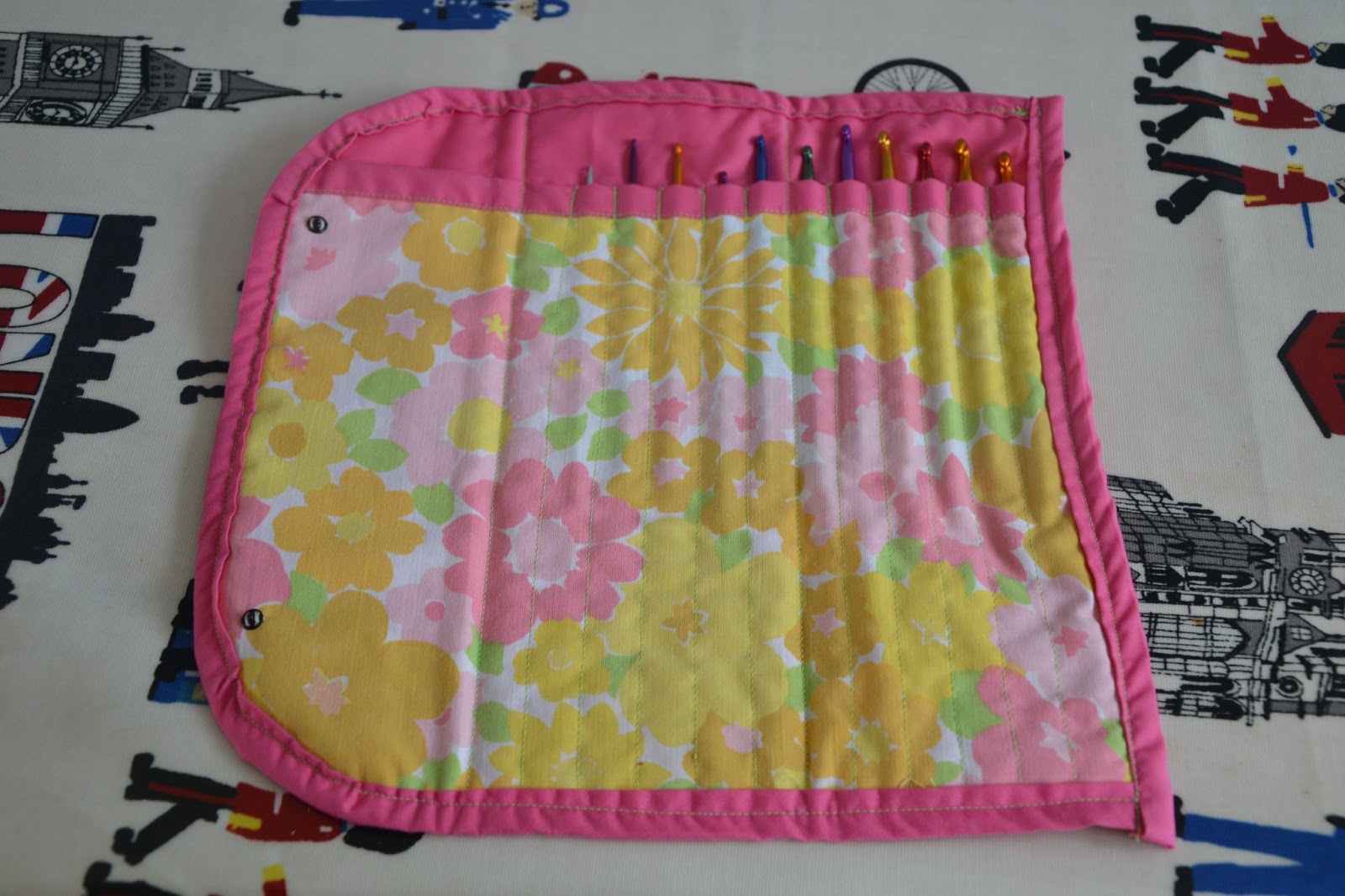
This week is my Sisters birthday. She is a fellow 'crafter' and has recently invested in a set of Tunisian crochet hooks. I decided to make her a case to keep her hooks in. This is what I did:
First I chose a fat quarter of this vintage fabric to be the main fabric and a coordinating plain fabric for the lining and binding. 
The hooks are just less than 30cm long so I also made it 30cm tall. I cut a 30x30cm square from both fabrics and a 20cm square from the main fabric.
 I needed her case to be long enough for 12 hooks and I wanted 1.5cm width for each 'hook pocket'. I also needed an extra 10cm to make a flap to close it. Therefore I needed the case to be 30cm wide (12x1.5+10).
I also needed a 30x30cm square of wadding (batting). I didnt have quite the right size in my thinnest wadding so I made it up from two rectangles which hasnt affected the final result but it would be easier to cut one square.
I then made a 30cm peice of bias binding and stitched this along one long edge of the rectangle of the main fabric. 
I then used a dressmakers pen and my quilters ruler to draw 13 lines on the rectangle. The first line was about 1cm in from the right (if the bias binding was at the top) and then marked 12 more lines each 1.5cm to the left of the previous one.
I then pinned this rectangle to the square of the plain fabric, lining up the bottom of the rectangle with one edge of the plain square (should have photographed this, sorry!) I then stitched along all the lines except the 1st, 7th and 13th line. To make sure the 'hook pockets' are strong I stitched forward and back along the very top of the pocket where the bias binding is. The picture below shows this better.
I then trimmed the threads.
I then lay the large square of main fabric face down on the mat. I lay the wadding on top, lining up the edges. then I lay the pockets on top of this face up.
Then I stitched along the 1st, 7th and 13th lines from the very top to the bottom.
I then curved round the corners on the left hand side, I made it symmetrical by folding these in half and doing both together but I did it freehand.
I then stitched binding around the curved edge. I was lazy and didn't actually make 'bias' binding so that's why it doesn't lie flat but after ironing it it looked a little better.
I then stitched another piice of binding down the remaining edges, tucking in the corners as I went. I trimmed any remaining threads and washed off the dressmakers pen marks. 
I then hand stitched in some poppers and voila:
I hope she likes it! Zoe xx

P.S She did.


Related Posts Plugin for WordPress, Blogger...